
Conway Twitty and the Art of Making Heartbreak Sound Beautiful — The Story, Emotion, and Lasting Meaning Behind a Voice That Still Lives in Modern Roots…
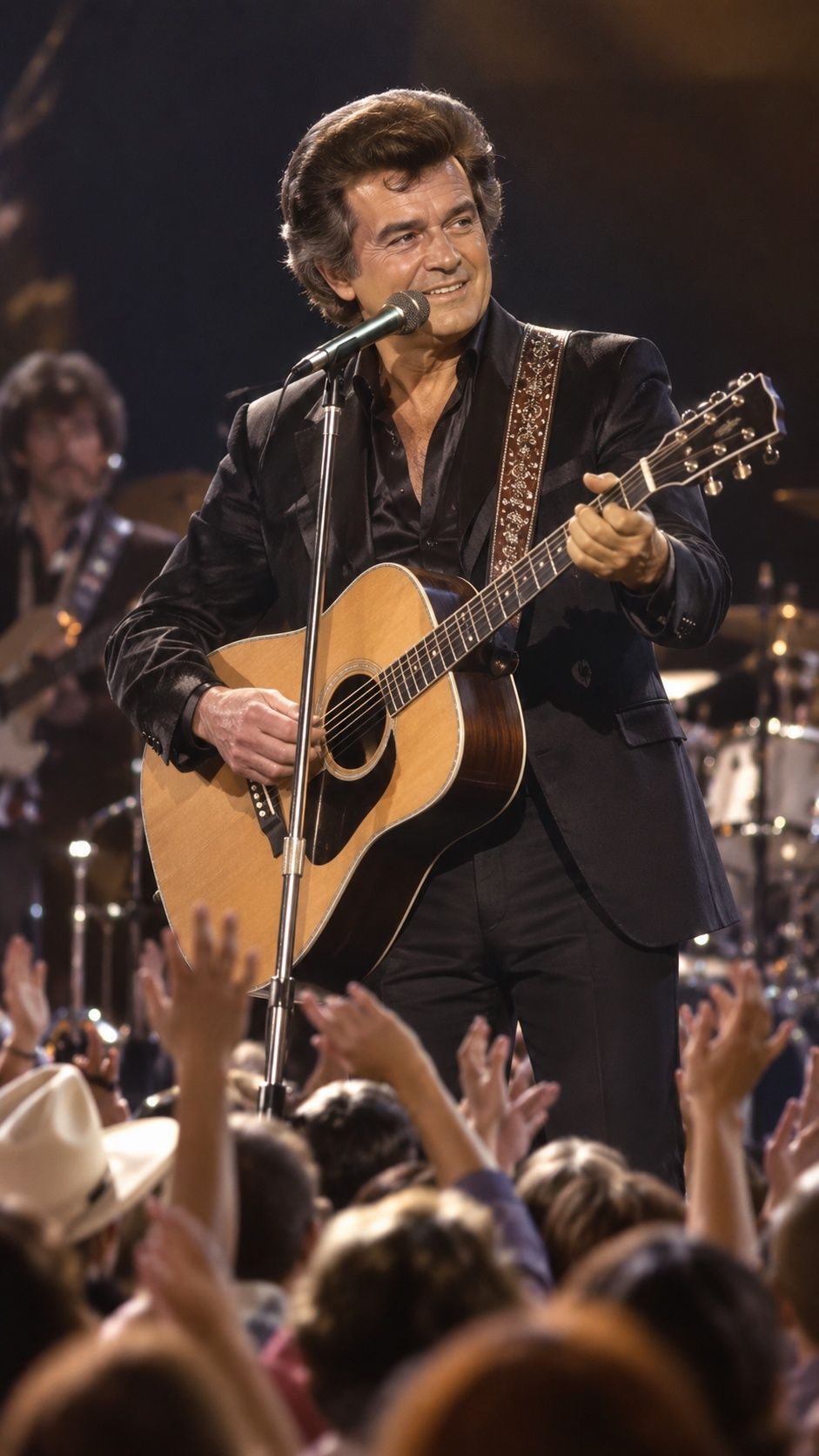
Some voices do more than carry a melody. They carry memory.
Conway Twitty possessed one of those rare voices. Smooth yet weathered, intimate yet commanding, his singing could make a simple country lyric feel like a private confession whispered across a kitchen table at midnight. Long after the recording ended, there was often an emotional residue left behind—the feeling that someone had just told you a truth you were not quite ready to hear.
Twitty’s remarkable career stretched across musical eras and genres, beginning with rock and roll before evolving into one of country music’s most distinctive bodies of work. His transformation was not simply a change in musical direction. It was an exploration of character, vulnerability, desire, regret, and the complicated spaces between people.
What makes Conway Twitty particularly fascinating today is how modern roots music continues to value the qualities he understood instinctively: storytelling over spectacle, emotional detail over technical showmanship, and authenticity over perfection.
His greatest recordings did not demand attention. They earned it.
And that may be the secret behind their endurance. Decades later, the songs still feel personal because Twitty understood something fundamental about country music: the most powerful stories are rarely about extraordinary lives. They are about ordinary people standing at extraordinary emotional crossroads.
THE JOURNEY FROM ROCK AND ROLL TO COUNTRY
Before becoming a defining figure in country music, Conway Twitty experienced success as a rock and roll performer. That early chapter matters because it gave him an unusual musical foundation.
He learned how to command a performance, shape a phrase, and communicate through rhythm before country music became his primary artistic home.
When he increasingly embraced country, he did not simply abandon his earlier musical identity. He carried elements of it forward. There was confidence in his delivery, a dramatic instinct in his phrasing, and an awareness of how a vocalist could make a listener feel as though a song were happening in real time.
That combination became central to his country persona.
Twitty could sing with restraint, but he also understood when a lyric needed emotional pressure. A pause could become as important as a note. A slight change in vocal texture could suggest hesitation, longing, or regret.
This sensitivity helped distinguish him from singers who approached country primarily as a showcase for vocal technique.
For Twitty, the voice was a character.
THE POWER OF EMOTIONAL DETAIL
The enduring appeal of Conway Twitty is closely connected to his understanding of emotional detail.
His recordings often revolved around relationships, separation, temptation, reconciliation, memory, and uncertainty. These themes are hardly unique to country music. What made Twitty effective was the specificity with which he inhabited them.
He did not merely sing that someone was heartbroken.
He sounded like someone remembering exactly where the heartbreak happened.
That distinction is enormous.
Country music has always depended upon emotional credibility. A listener may forget an elaborate arrangement, but they remember a line that seemed to describe something they had lived themselves.
Twitty had an instinct for that kind of connection. His phrasing frequently made lyrics feel conversational, as though the boundary between singer and listener had disappeared.
That quality remains particularly relevant to modern roots music, where artists increasingly embrace imperfections, conversational vocals, intimate arrangements, and narratives grounded in everyday experience.
WHY HIS VOICE STILL MATTERS
There is a misconception that musical influence always sounds obvious.
Sometimes it does. A later artist may directly imitate a vocal style, arrangement, or songwriting technique.
But influence can also operate at a deeper level.
Conway Twitty demonstrated how emotional storytelling could become the center of a commercial country recording without sacrificing musical sophistication. His success helped establish the idea that vulnerability could be powerful and that romantic storytelling could sustain an entire artistic identity.
His voice occupied an interesting space.
It could be tender without becoming fragile. It could be dramatic without becoming theatrical. It could suggest confidence while simultaneously revealing uncertainty.
That contradiction was part of his magic.
Modern roots performers often work within similar contradictions. They may combine traditional instrumentation with contemporary production, or old-fashioned storytelling with modern emotional language.
Twitty’s career provides an important historical example of how tradition and reinvention can coexist.
THE HUMAN STORIES BEHIND THE SONGS
Perhaps the greatest reason listeners still remember Conway Twitty is that his songs rarely feel emotionally distant.
Even when the circumstances are dramatic, the emotions are recognizable.
A relationship begins.
Someone leaves.
Someone regrets a decision.
Someone wants another chance.
Someone remembers what once existed.
These are timeless human experiences.
Twitty’s recordings transformed such situations into emotional scenes. Rather than treating heartbreak as an abstract concept, his performances often made it feel physical and immediate.
You could hear hesitation.
You could hear desire.
You could hear resignation.
And sometimes you could hear the dangerous optimism that comes with believing a broken relationship might still be repaired.
That emotional vocabulary is one reason his work continues to resonate with listeners who were not even alive during the height of his career.
CONWAY TWITTY AND THE ART OF RESTRAINT
One of the most interesting aspects of Twitty’s artistry was his understanding of restraint.
Great emotional singing is not necessarily about singing louder.
Sometimes the opposite is true.
A quiet phrase can create more tension than a dramatic climax because it forces the listener closer. Twitty frequently understood this psychological dimension of performance.
His strongest moments could feel almost private.
That intimacy is especially important when considering his legacy through the lens of modern roots music. Today’s roots-oriented artists often rely on close-miked vocals, sparse instrumentation, room ambience, and deliberately understated performances.
The aesthetic may sound contemporary, but the underlying principle is old:
Make the listener feel close to the story.
Twitty understood that principle extraordinarily well.
THE CULTURAL MEMORY OF CONWAY TWITTY
Artists become legends for different reasons.
Some are remembered for innovation. Others are remembered for extraordinary musicianship, cultural impact, songwriting, or sheer popularity.
Conway Twitty occupies a fascinating place because his legacy rests heavily on emotional identification.
Listeners remember particular songs because those songs became attached to moments in their own lives.
A breakup.
A long drive.
A marriage.
A lonely evening.
A memory of someone who is no longer there.
This is one of the highest achievements a recording can accomplish. The artist creates the song, but eventually the audience takes ownership of its meaning.
Once that happens, the song becomes part of personal history.
HIS LEGACY IN MODERN ROOTS MUSIC
Modern roots music is not one sound. It is a conversation between generations.
It draws from country, folk, blues, Americana, traditional rock, bluegrass, gospel, and other forms of American musical storytelling.
Within that conversation, Conway Twitty remains relevant because he represented a fundamental idea: emotional honesty can survive changing production styles.
A contemporary recording might use different instruments.
A modern vocalist might sing with a completely different accent.
A songwriter might approach relationships through a different cultural lens.
But the emotional architecture remains remarkably familiar.
People still fall in love.
People still leave.
People still make mistakes.
People still wonder what might have happened if they had chosen differently.
Those are the subjects that made Twitty’s music durable in the first place.
THE LEGACY OF A VOICE THAT UNDERSTOOD PEOPLE
Ultimately, the lasting meaning of Conway Twitty cannot be reduced to chart success or nostalgia.
His importance lies in the emotional bridge he built between performer and listener.
He understood that country music works best when it feels lived rather than performed.
His voice could make polished studio recordings feel personal. His delivery could transform familiar romantic themes into moments of genuine tension. And his ability to inhabit complicated emotions gave his songs a longevity that extends far beyond their original era.
That is why his influence still matters.
The soundscape changes.
The technology changes.
The clothes change.
The audiences change.
But the human heart remains stubbornly familiar.
And somewhere inside that continuity, Conway Twitty still sings.
Not simply as a relic of country music’s past, but as a reminder of what great roots music has always been capable of doing: taking an ordinary human experience and turning it into something unforgettable.
Because the deepest country songs do not merely tell us what happened.
They remind us how it felt.